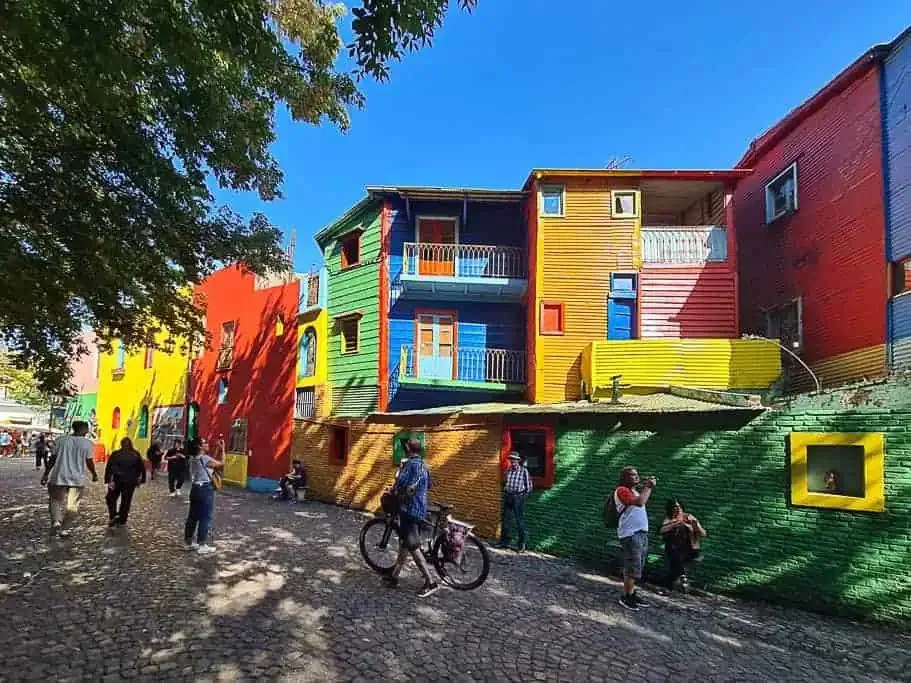
Exploring Buenos Aires landmarks is a way to understand the different worlds that shaped Argentina’s capital. In La Boca, colorful houses and a legendary soccer stadium introduce the neighborhood’s artistic and sporting traditions. Around Plaza San Martín, grand residences and a pioneering skyscraper tell a different story of wealth, ambition, and architectural change.
This guide brings together seven places for travelers interested in the city’s history and culture. Whether you are planning your first visit or exploring famous landmarks in Argentina, these stops offer a varied introduction to Buenos Aires.
1. Caminito: Colorful Houses and La Boca’s Artistic Identity
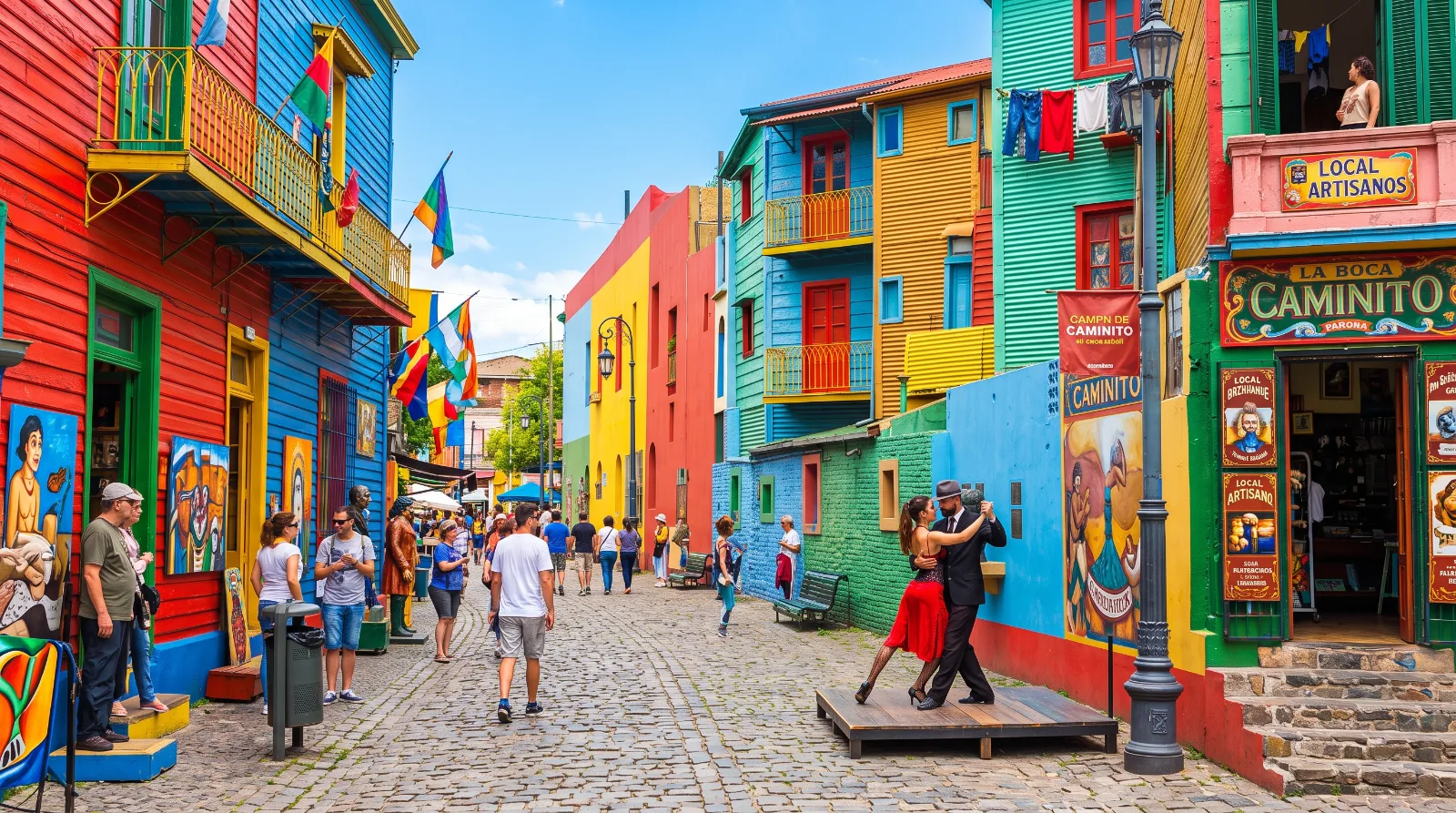
Caminito is an open-air street museum in La Boca, recognizable for its brightly painted façades and outdoor artwork. Its wood and corrugated-metal buildings reflect the neighborhood’s traditional conventillos: shared dwellings associated with the immigrants who settled near the port.
The street’s appearance also owes much to artist Benito Quinquela Martín and the residents who helped revive this abandoned railway passage during the 1950s. Their work turned it into a place where art became part of the neighborhood’s public landscape.
Walk slowly, look at the buildings and sculptures, and consider the contrast between the street’s present-day popularity and its origins in a working port district. Caminito’s appeal extends beyond its colors to the people who shaped La Boca.
2. La Bombonera: Boca Juniors’ Legendary Stadium
La Bombonera, home of Boca Juniors, brings soccer into any exploration of Buenos Aires landmarks. The stadium is closely associated with Diego Maradona and with the sporting identity of La Boca, where the club occupies a central place in neighborhood life.
An exterior stop pairs naturally with Caminito, giving visitors two perspectives on the same district. One introduces its artistic traditions; the other reveals the importance of soccer and belonging.
For those who want to explore the club’s past, the Museo de la Pasión Boquense provides additional historical context. When planning your itinerary, distinguish between seeing the stadium from outside, visiting the museum, and attending a match: these are separate experiences.
3. The Obelisk: Buenos Aires’ Most Recognizable Monument
The Obelisk rises above the intersection of 9 de Julio and Corrientes avenues. Designed by architect Alberto Prebisch, it was inaugurated in 1936 to commemorate the 400th anniversary of Buenos Aires’ first foundation.
At approximately 67.5 meters tall, its geometric silhouette creates a striking focal point amid the surrounding traffic and buildings. It is an essential stop for understanding how the city expressed its modern identity during the twentieth century.
Take in the monument from the surrounding pedestrian areas, then continue along Corrientes to explore an avenue associated with theaters and entertainment. The setting is as much part of the experience as the monument itself.
4. The Kavanagh Building: Corina Kavanagh’s Architectural Legacy
The Kavanagh Building stands beside Plaza San Martín, its stepped profile offering a distinctive contrast with the district’s older residences. Commissioned by Corina Kavanagh and inaugurated in 1936, the approximately 120-meter skyscraper became an architectural symbol of Buenos Aires.
Designed by Sánchez, Lagos, and De la Torre, it combines Art Deco influences with geometric volumes and terraces. Its ambitious residential design reflects the emergence of a new form of urban luxury.
From the square, look at how its shape changes as you move around it. For architecture enthusiasts, the Kavanagh is a rewarding example of how a modern building can establish its own identity within a historic neighborhood.
5. Palacio San Martín: From Family Residence to Diplomatic Landmark
Palacio San Martín introduces visitors to the French-inspired architecture favored by Buenos Aires’ wealthy families in the early twentieth century. Designed by Alejandro Christophersen for the Anchorena family, the complex originally contained three residences behind a unified architectural composition.
The Argentine government acquired the property in 1936, and it later became the ceremonial headquarters of the Foreign Ministry.
An exterior stop offers an opportunity to examine its elaborate façade and discuss the families who once lived around Plaza San Martín. Pair it with the nearby Kavanagh Building to compare two visions of prestige: the aristocratic palace and the modern residential skyscraper.
6. Casa Rosada: The Pink House and Eva Perón’s Balcony
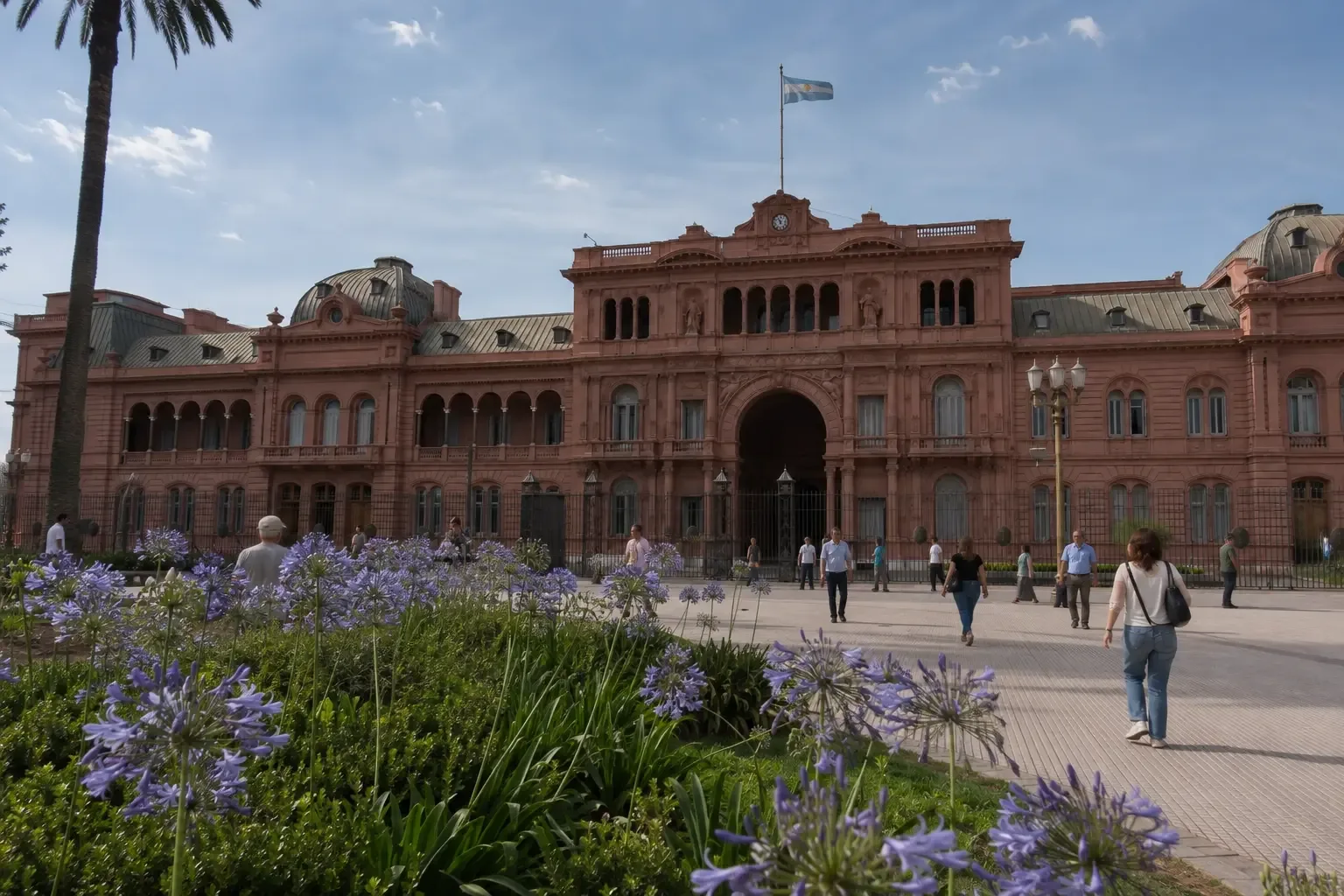
Facing Plaza de Mayo, the Casa Rosada houses Argentina’s presidential offices. Its distinctive pink façade makes it one of the most recognizable landmarks in Argentina, while its balconies connect the building with some of the country’s most influential political figures.
From these balconies, Juan and Eva Perón addressed their supporters during the late 1940s and early 1950s. Looking up from the square helps visitors understand the relationship between the government building and the crowds who gathered before it.
The exterior also rewards architectural attention, particularly its monumental central arch. A visit to Plaza de Mayo provides the setting for discussing Evita’s influence, presidential power, and the public life of the city.
7. Teatro Colón: Architecture, Opera, and Acoustics
Teatro Colón adds music and performance to this selection of Buenos Aires landmarks. Celebrated for its architecture and acoustics, the opera house is a major expression of the city’s cultural ambitions and its long-standing relationship with classical music.
Its appeal extends to travelers who would not normally attend an opera. The building itself offers a reason to include it in an itinerary focused on architecture, while a performance provides a different way to experience the space.
Consider whether you want an exterior stop, an interior visit, or an evening performance when organizing your day. Each offers a different perspective on this celebrated cultural institution.
How to Organize Your Buenos Aires Landmarks Tour
For planning purposes, group these seven stops into three parts of your itinerary:
La Boca: Caminito and La Bombonera.
Downtown: Casa Rosada, the Obelisk, and Teatro Colón.
Plaza San Martín: the Kavanagh Building and Palacio San Martín.
Start by deciding which places you want to enter. A route focused on exterior stops leaves more time to move between neighborhoods, while museum visits, theater interiors, and performances require additional planning.
For a more relaxed experience, divide the sights across two outings or arrange transportation between the different areas. Leave room for photographs, questions, and breaks instead of treating every stop as a quick photo opportunity.
Frequently Asked Questions
Which Buenos Aires landmarks should I visit first?
For a varied introduction, start with Caminito, the Obelisk, and Casa Rosada. Add Teatro Colón for performing arts and architecture, La Bombonera for soccer, and the buildings around Plaza San Martín for an architectural comparison.
Can I see all seven landmarks in one day?
A day focused primarily on exterior stops is a practical option with transportation between neighborhoods. If you want to include several interior visits, consider spreading the itinerary across two days.
Are these landmarks suitable for an architecture-focused itinerary?
Yes. The Kavanagh Building, Palacio San Martín, Casa Rosada, and Teatro Colón offer contrasting approaches to residential, diplomatic, governmental, and cultural architecture. Caminito adds another perspective through the neighborhood’s traditional building materials and shared housing.
Explore Buenos Aires with a Local Guide
Discover these landmarks through the stories that connect them. On HolaGuides, explore private tours and choose a local guide whose interests match yours, whether you want to focus on architecture, history, art, or soccer. Plan directly with your guide to organize a route and pace that suit your visit.