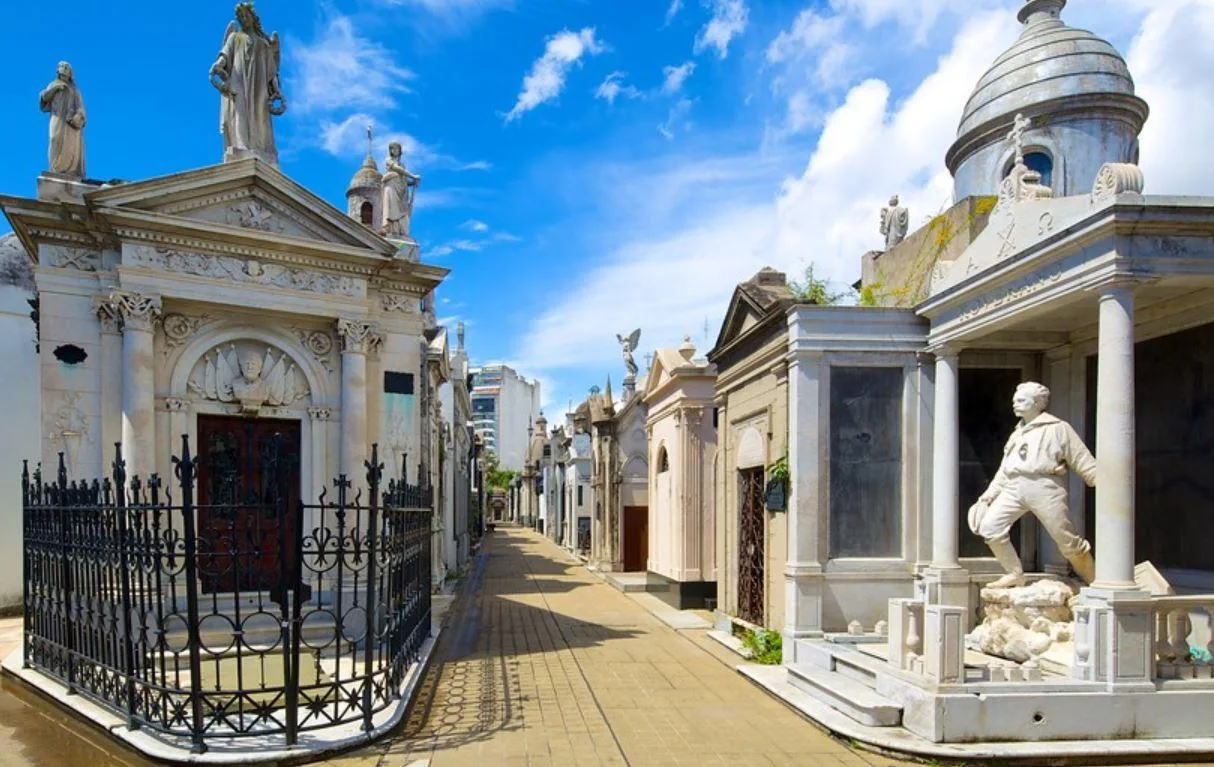
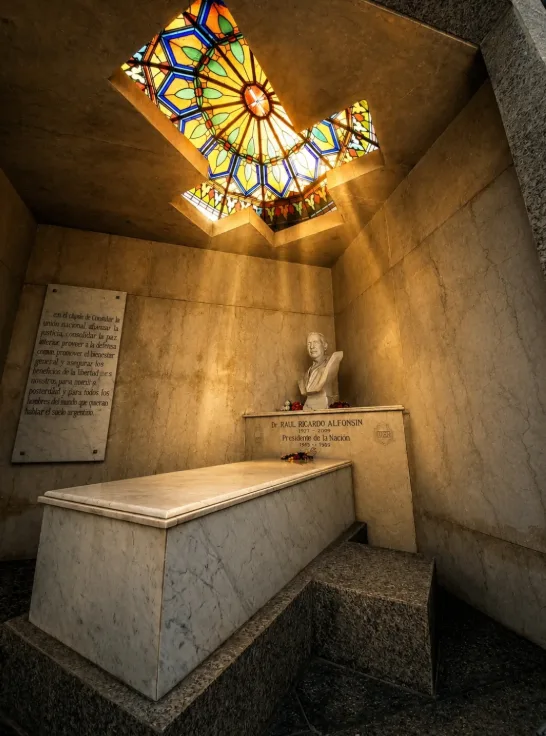
Among the mausoleums of Recoleta Cemetery, Raúl Alfonsín’s tomb offers a connection to Argentina’s recent history. The former president, who led the country’s return to democracy in 1983, rests in a monument that brings together architecture, sculpture and the words of the Argentine Constitution.
For travelers exploring Buenos Aires, this is a meaningful stop: a place to discover why Alfonsín remains closely associated with the restoration of civilian government after the dictatorship of 1976–1983.
Who Was Raúl Alfonsín?
Raúl Ricardo Alfonsín won Argentina’s presidential election on October 30, 1983, and took office on December 10. His presidency, which lasted until July 1989, marked the beginning of the democratic period that followed the last military dictatorship.
One of the defining events of his administration was the 1985 Trial of the Juntas, in which former military rulers faced prosecution before a civilian court. His government also established CONADEP, the commission that investigated forced disappearances and produced the report Nunca Más.
His legacy includes difficult and contested decisions. The Full Stop and Due Obedience laws restricted accountability for dictatorship-era crimes, illustrating the tensions surrounding the democratic transition. Understanding that history gives the monument greater depth: it commemorates a president whose administration faced both the possibilities and the pressures of rebuilding democratic institutions.
When Was Alfonsín Buried in Recoleta?
Alfonsín died on March 31, 2009. His remains initially rested in Recoleta’s pantheon honoring those who fell in the Revolution of 1890, a monument associated with the history of the Radical Civic Union, or UCR.
On May 16, 2009, his remains were transferred to a mausoleum built specifically for him. The transfer took place in a private ceremony attended by relatives and close friends.
A separate public event followed on October 30, 2009, when the mausoleum was officially inaugurated and its sculpted bust unveiled. The date marked the 26th anniversary of Alfonsín’s electoral victory.
These two dates explain why accounts of the tomb sometimes mention May and others October: the burial in the new mausoleum preceded its formal inauguration.
Who Designed the Tomb?
The mausoleum was designed by architects Luis Cabillón and Pablo Turchet. Contemporary reports credit them with the overall design, including the stained-glass window.
Its materials combine a pearl-gray façade with Botticino marble inside. Carrara marble was used for the sarcophagus and the plaque bearing an excerpt from the Constitution’s preamble. A cross crowns the structure, while stained glass introduces color and light into the interior.
The combination of a presidential portrait, national and party emblems, and constitutional text gives visitors several ways to read the monument. It recalls Alfonsín as a person, a political leader and a figure in Argentina’s democratic history.
The Bust by Luciano Garbati
The portrait bust is the work of sculptor Luciano Garbati. Carved from Carrara marble, it was unveiled at the October 30 inauguration.
A July 2009 report preserved on the UCR’s Buenos Aires website describes how Garbati developed the portrait using photographs supplied by Alfonsín’s family, drawing particularly on an image used for an Argentine postage stamp. The work progressed from a clay model to plaster before being translated into marble.
That account also records the family’s involvement during its creation. The bust was intended to offer a recognizable likeness of the former president, giving the memorial a personal focus alongside its institutional symbols.
Why Is the Constitution Inscribed on the Monument?
The inscription reproduces part of the preamble to Argentina’s Constitution, invoking national unity, justice, domestic peace, general welfare and liberty.
Its presence has a particular connection to Alfonsín. During his 1983 election campaign, he recited the preamble at political rallies, including his closing campaign speech in Buenos Aires. Constitutional language became part of his appeal for the recovery of democratic government.
Read with that background, the inscription links the tomb to the public speeches through which many Argentines came to know him. It offers a useful detail to pause over during a cemetery visit.
Visiting Alfonsín’s Tomb
Recoleta Cemetery’s entrance is at Junín 1760, in Buenos Aires’ Recoleta neighborhood. Ask for the location of the mausoleo de Raúl Alfonsín when planning your route through the cemetery.
Allow time to look at the bust, the marble inscription and the stained glass where visible. The cemetery remains a burial ground, so observe the monument from public paths and respect any restrictions on access.
A visit can also include other political and cultural figures buried in Recoleta. Exploring these monuments together helps reveal how the cemetery preserves different—and sometimes competing—visions of Argentina’s past.
Explore private Recoleta Cemetery tours on HolaGuides and connect with a local guide to plan a visit around the stories that interest you most.
Sources
- Casa Rosada: Presidential biography, election and inauguration dates. 2009)
- Argentine National Memory Archive: Alfonsín’s human rights policies, CONADEP and the laws restricting prosecutions. argentina.gob.ar
- Argentine government: Historical account of the 1985 Trial of the Juntas. Argentina.gob.ar
- APFDigital, May 17, 2009: Transfer of the remains, architects and architectural features. APFDigital
- UCR CABA, July 13, 2009, reproducing Clarín reporting: Architects, sculptor and the process of creating the bust. UCR CABA
- El Ancasti and La Noticia Web, October 30, 2009: Marble materials, formal inauguration and unveiling of the bust. elancasti.com.ar
- Archivo Prisma: Archival footage of Alfonsín’s October 26, 1983 campaign speech and his recitation of the constitutional preamble. Archivo Prisma
- Buenos Aires official tourism website: Cemetery location and visitor information.