At the corner of Chile and Defensa, a little girl with a bow in her hair shares a bench with two friends. Visitors stop for photographs, but the characters sitting beside them have more to say than their cheerful appearance suggests.
This is Mafalda’s corner, the starting point of the Paseo de la Historieta, or Comic Strip Walk. Its sculptures and murals introduce visitors to Argentine cartoon characters and the artists who created them. For travelers exploring San Telmo, it offers a different way to discover Buenos Aires: through its humor, everyday life, and habit of questioning almost everything.
What is the Paseo de la Historieta?
The Paseo de la Historieta is an outdoor route honoring Argentina’s comic strips and graphic humor. Its best-known starting point is beside San Telmo, at the boundary with Monserrat, while the broader circuit continues toward Puerto Madero.
The appeal goes beyond recognizing familiar faces. These characters bring different versions of Argentine life into the street: children puzzling over adult behavior, a charming man avoiding responsibility, a passionate soccer supporter, and a gaucho whose conversations turn rural life into satire.
You do not need to know the comics before visiting. A little context helps transform a series of photo stops into an introduction to the country’s culture.
Start with Mafalda, Susanita, and Manolito
Created by Quino, Mafalda appeared as a newspaper and magazine comic strip between 1964 and 1973. She is a child trying to understand a world whose adults rarely seem to have convincing answers.
Her concerns reach far beyond school and family life. Peace, inequality, politics, and women’s place in society all enter her conversations. Although the strip reflects the Argentine middle class of its time, its questions travel easily across borders.
Her friends offer contrasting perspectives. Susanita dreams of marriage and a comfortable family life. Manolito approaches the world through business and his father’s grocery store. Together, their exchanges turn ordinary childhood conversations into sharp social observation.
The sculptures stand at Chile and Defensa. A few steps away, Chile 371 marks the building where Quino lived while developing the strip, linking this internationally known character to a very specific Buenos Aires neighborhood.
Beyond Mafalda: Meet the Other Characters
From the bench, follow Chile toward Balcarce, then turn left onto Balcarce toward Avenida Belgrano. The city’s published route introduces several other figures along this stretch:
- Isidoro Cañones, created by Dante Quinterno, is a carefree playboy with a taste for the good life.
- Larguirucho and Super Hijitus, by Manuel García Ferré, bring good-hearted comedy and superhero adventures into the walk.
- Matías, by Sendra, looks at everyday life with a child’s curiosity.
- Don Fulgencio, by Lino Palacio, is an adult whose behavior keeps childhood close.
- Clemente, by Caloi, brings Argentina’s love of soccer into the picture.
- The Chicas de Divito recall a distinctive era of Argentine magazine illustration and fashion.
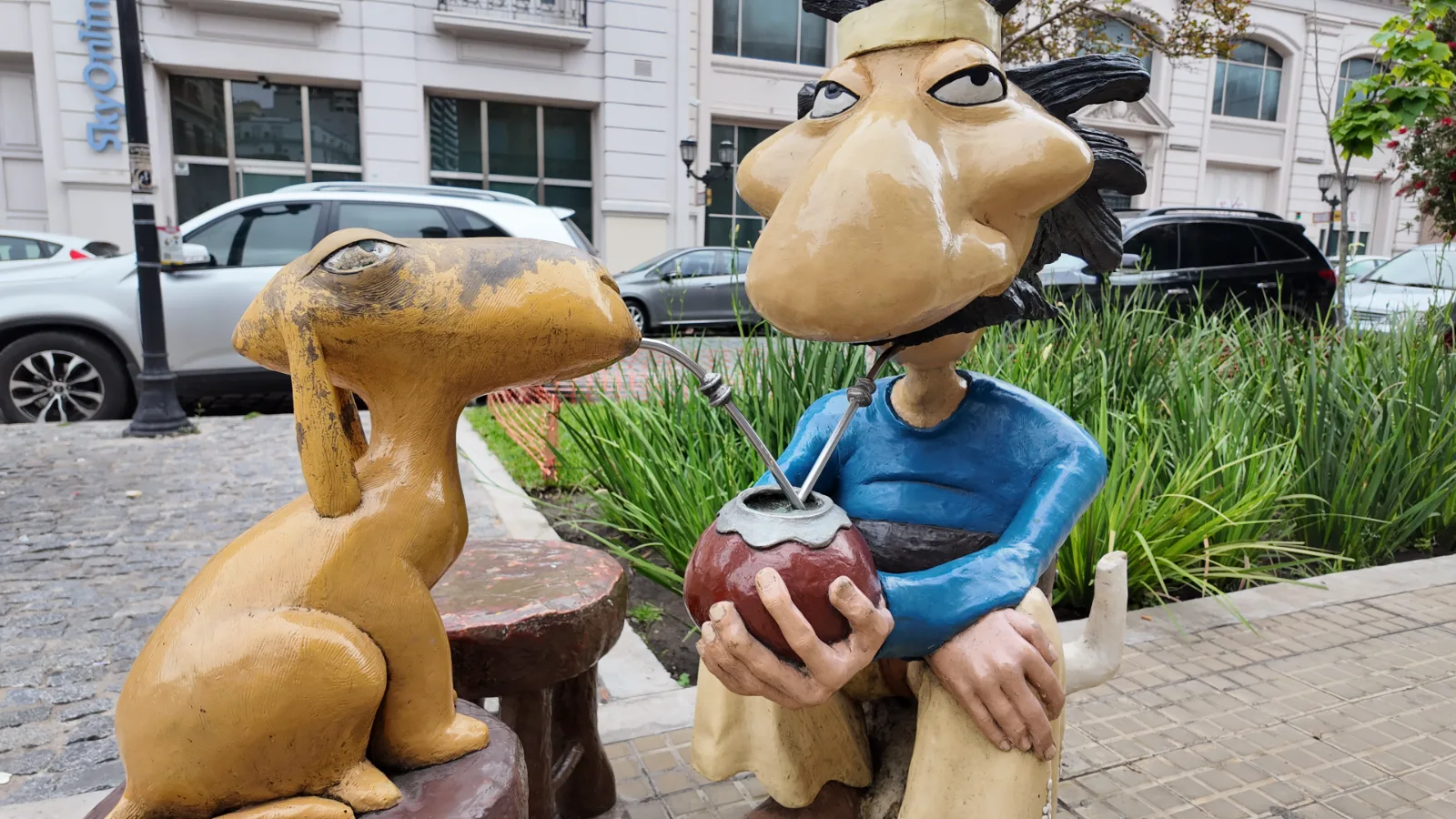
Farther along the broader route, other characters include Patoruzú and the gaucho Inodoro Pereyra with his dog Mendieta. Rather than trying to recognize everyone, choose a few characters and discover what made them meaningful to Argentine readers.
How to Include the Walk in a San Telmo Visit
For a relaxed visit, treat the sculptures around Chile and Balcarce as one part of a wider neighborhood walk. You can then return to Defensa and continue south toward the San Telmo Market and Plaza Dorrego.
This is a separate direction from continuing the comic circuit toward Puerto Madero. Choosing between the two makes planning easier: stay in San Telmo for markets, cafés, and antiques, or follow more of the sculptures toward the waterfront.
The covered San Telmo Market combines food stalls, antiques, and historic architecture, making it a useful place for a break.
Visiting on a Sunday? You can also explore San Telmo’s open-air Sunday market. The antiques fair at Plaza Dorrego and the stalls along Defensa make it easy to combine the comic walk with browsing antiques, crafts, and souvenirs. Allow extra time to wander and enjoy the street atmosphere. The Sunday fair is separate from the covered San Telmo Market, which you can also include in your visit.
Practical Tips for Your Visit
Cost and access: The sculptures are in public streets, so there is no admission ticket for the outdoor walk.
Time to allow: As a planning suggestion, set aside around 45–60 minutes for Mafalda and several nearby stops, allowing longer for photographs, a café break, or the extended route.
Walking conditions: San Telmo has cobblestones and uneven surfaces. Wear comfortable shoes and plan a shorter section if walking comfort is a concern.
Route planning: Consult the city’s route map for the broader circuit. Individual sculptures may occasionally be unavailable for maintenance.
Discover the Stories Behind the Statues
The Paseo de la Historieta rewards a slower look. Behind its colorful figures are arguments about ambition, family, class, national identity, and the strange logic of everyday life.
For visitors, that makes it more than a collection of souvenirs in three dimensions. It is an invitation to understand what has made generations of Argentines laugh—and what they have used humor to question.
Explore private Buenos Aires tours on HolaGuides and ask a local guide about including Mafalda’s corner and the Paseo de la Historieta in your San Telmo itinerary. Plan the walking distance, stops, and pace directly with your guide.
Sources
- Buenos Aires tourism board — official route and characters:
https://turismo.buenosaires.gob.ar/es/atractivo/paseo-de-la-historieta-0 - Buenos Aires City — sculptures, murals, and graphic humor:
https://buenosaires.gob.ar/gcaba_historico/cultura/casco-historico/visita-el-paseo-de-la-historieta - Buenos Aires tourism board — Mafalda, neighborhood context, and Quino's former home:
https://turismo.buenosaires.gob.ar/es/article/mafalda-de-hoy-y-de-siempre - Buenos Aires City — Mafalda's themes and publication period:
https://buenosaires.gob.ar/gcaba_historico/cultura/casco-historico/mafalda - Buenos Aires City — character profiles:
https://buenosaires.gob.ar/gcaba_historico/construccionciudadana/paseodelahistorieta - Visit Argentina — Mafalda circuit and Chile 371:
https://www.argentina.travel/novedades/el-circuito-de-mafalda-en-buenos-aires - Buenos Aires tourism board — Defensa and Sunday activity:
https://turismo.buenosaires.gob.ar/es/otros-establecimientos/calle-defensa - Buenos Aires tourism board — San Telmo Market:
https://turismo.buenosaires.gob.ar/es/otros-establecimientos/mercado-san-telmo