For visitors, the challenge is not finding impressive tombs—it is understanding what they reveal. A walk through Buenos Aires Recoleta Cemetery can connect the country’s political conflicts, immigration, public health, art and social ambitions. You can explore independently, but a local guide is particularly useful when you want to go beyond the names and recognize the stories hidden in the architecture.
What is Recoleta Cemetery?
La Recoleta Cemetery is a historic public cemetery in the Recoleta neighborhood of Buenos Aires. It opened in 1822 on land associated with the Franciscan Recollect friars, known in Spanish as the recoletos. Their convent and the neighboring Basilica of Our Lady of the Pillar gave the area—and eventually the cemetery—its name.
This origin also clears up a frequent search confusion. Travelers sometimes type “Recoleta cemetary,” “Recoleta cementery,” “Recoleta cementary,” “Recoletta” or even names that sound like “Rigoletto.” The official name is Cementerio de la Recoleta, or Recoleta Cemetery in English. It has nothing to do with Verdi’s opera Rigoletto; “Recoleta” comes from the Recollect religious order connected with this part of the city.
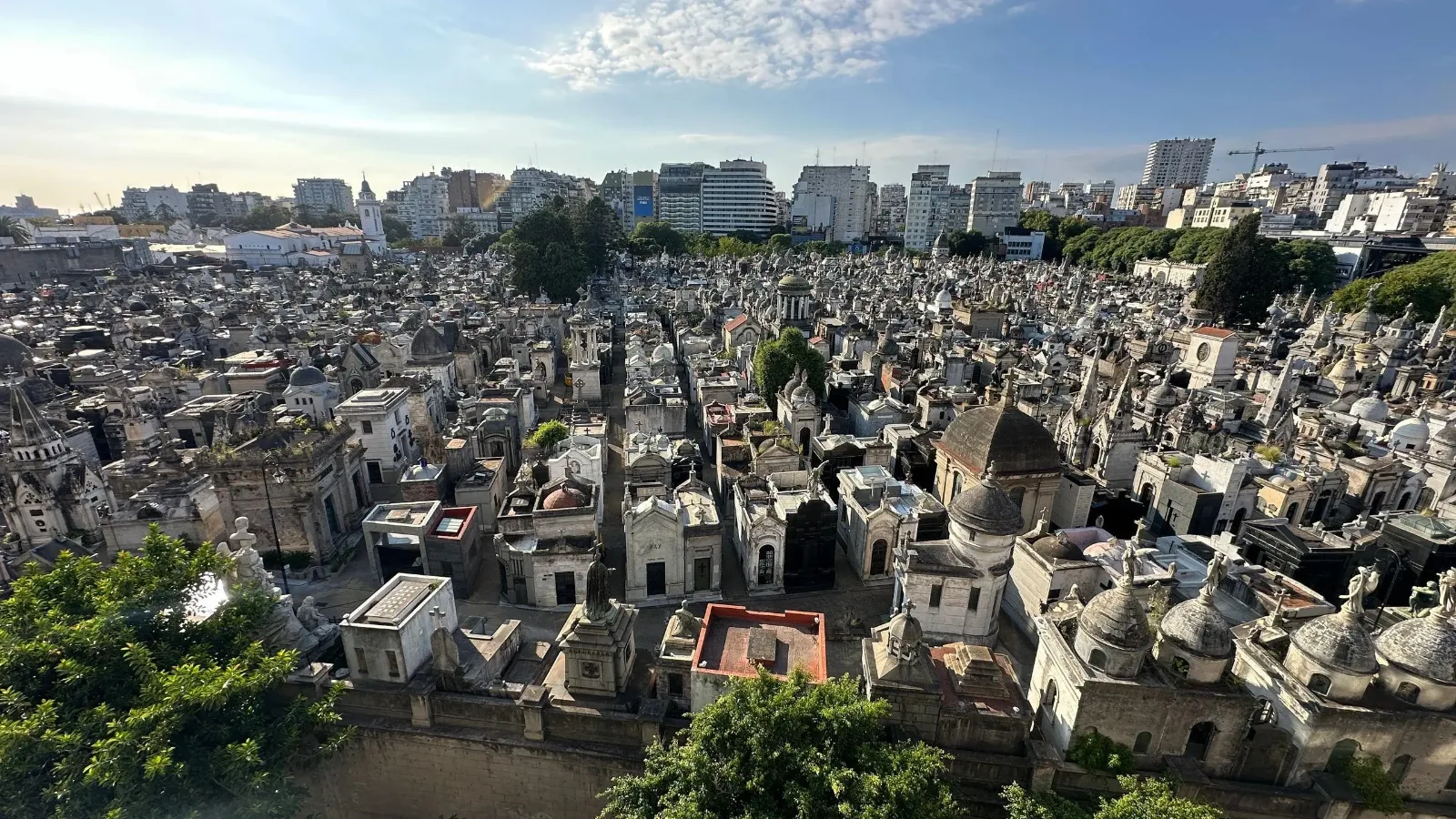
The cemetery occupies roughly five and a half hectares and contains thousands of above-ground vaults. More than 90 of them have been declared National Historical Monuments. Its layout resembles a compact city: broad central avenues branch into narrow passages lined with private family mausoleums.
A brief history of Recoleta Cemetery
When it opened in 1822, Recoleta became Buenos Aires’ first public cemetery. Its original plan was prepared by French engineer Próspero Catelin. As the city expanded and Argentina’s political and commercial elite grew wealthier, the cemetery became a preferred burial place for influential families.
In 1881, during the modernization of Buenos Aires, architect Juan Antonio Buschiazzo redesigned the grounds. Many of the elaborate mausoleums visitors see today belong to the decades when local families imported marble, stained glass and artistic fashions from Europe. The result is an extraordinary concentration of Neoclassical, Neo-Gothic, Art Nouveau, Art Deco and Baroque-inspired funerary architecture.
Recoleta Cemetery therefore tells two histories at once. The names on the tombs trace the formation of the Argentine nation, while the buildings show how the country’s upper classes wanted to present themselves to future generations.
Why is Recoleta Cemetery famous?
The grave of Eva Perón attracts the largest crowds, but the cemetery is internationally known for the density of its architecture and the range of people buried there. Former presidents stand near Nobel Prize winners, military figures, physicians, athletes and families remembered through tragic or mysterious stories.
It is also an unusually visual historical site. Bronze doors, carved angels, glass panels, Masonic motifs, Christian imagery and portrait sculptures turn a walk into an open-air lesson in art and symbolism. Some vaults remain immaculate; others show cracked glass, weathered stone or plants emerging from old structures. That contrast is part of the cemetery’s character.
Famous graves and stories to find
Eva Perón and the Duarte family vault
The most searched-for site in Recoleta Cemetery is the Eva Perón grave. Known around the world as Evita, Eva Duarte de Perón was Argentina’s first lady from 1946 until her death in 1952. She became an exceptionally powerful public figure through her work with labor groups, social assistance and women’s political rights. For many Argentines she remains a symbol of dignity and social justice; for others, her legacy is inseparable from the conflicts surrounding Peronism.
Her final resting place is not a monumental standalone tomb. She lies in the Duarte family vault, marked by dark stone and plaques left by visitors. The modest scale surprises many people who expect a structure matching her international fame.
The story did not end with her death. After the military coup that removed Juan Perón in 1955, Eva’s embalmed body disappeared for years and was secretly buried in Italy under another name. It later traveled to Spain, returned to Argentina and was finally placed in the Duarte vault in 1976. Knowing that journey makes the tomb far more meaningful than a quick photograph.
Luis Ángel Firpo, “The Wild Bull of the Pampas”
Boxing fans should look for Luis Ángel Firpo, the Argentine heavyweight nicknamed “The Wild Bull of the Pampas.” In 1923 he challenged Jack Dempsey for the world heavyweight title in New York. Firpo famously knocked Dempsey through the ropes and out of the ring before Dempsey returned and won the fight.
Firpo was the first Latin American to challenge for the world heavyweight championship, and his international success helped turn boxing into a mass spectacle in Argentina. A sculpture of the boxer identifies his mausoleum, making it one of the cemetery’s most recognizable sports-related memorials.
Salvador María del Carril and Tiburcia Domínguez: a disagreement for eternity
One of Recoleta’s most memorable marital stories belongs to Salvador María del Carril, Argentina’s first vice president, and his wife, Tiburcia Domínguez. Their monument includes representations of the couple facing away from each other.
The traditional explanation is that years of conflict over family spending and debts damaged their relationship. Del Carril publicly declared that he would no longer be responsible for his wife’s debts, a humiliation Tiburcia reportedly never forgave. Whether every detail of the popular version can be proven or not, the arrangement of the figures has become the cemetery’s clearest image of a couple continuing their disagreement for eternity.
Raúl Alfonsín and Argentina’s return to democracy
Raúl Alfonsín served as president from 1983 to 1989 and is closely associated with Argentina’s return to constitutional democracy after the last military dictatorship. His government created the National Commission on the Disappearance of Persons and supported the historic Trial of the Juntas.
Visitors interested in modern Argentine history should include his tomb. It provides an important counterpoint to the cemetery’s 19th-century presidents and makes the site relevant to the country’s living democratic memory.
Rufina Cambaceres and “the girl who died twice”
Rufina Cambaceres died in 1902 on her 19th birthday. Her elegant Art Nouveau monument shows a young woman touching the door of her own mausoleum. It is one of the cemetery’s most photographed sculptures.
According to Recoleta’s best-known legend, Rufina was declared dead after suddenly collapsing but later awoke inside her coffin. Stories about a displaced coffin and scratch marks transformed her into “the girl who died twice.” The dramatic account is part of Buenos Aires folklore and should be presented as a legend rather than an established medical fact. What is certain is that the monument, commissioned by her grieving mother, turned Rufina into one of La Recoleta Cemetery’s enduring symbols.
Toribio Ayerza and Argentina’s first tracheotomy
Spanish-born physician Toribio Ayerza brought European medical knowledge to 19th-century Buenos Aires and is credited with performing the first tracheotomy in Argentina. The procedure helped save patients suffering from airway obstruction, particularly during an era when diphtheria threatened many children.
Ayerza later joined physician Guillermo Rawson in founding the Argentine Red Cross in 1880. His family mausoleum is a reminder that Recoleta preserves the history of public health as well as politics and wealth.
Domingo Faustino Sarmiento
President, writer and education reformer Domingo Faustino Sarmiento is buried beneath a distinctive monument topped by a bronze condor. His ideas about public education shaped Argentina, while his book Facundo became a foundational—and fiercely debated—work of Latin American literature and political thought.
Admiral Guillermo Brown
Irish-born William Brown, known in Argentina as Guillermo Brown, is regarded as the founder of the Argentine Navy. His tomb connects Recoleta to the independence era and also reflects the role immigrants played in building the country’s national institutions.
Luis Federico Leloir
Biochemist Luis Federico Leloir received the Nobel Prize in Chemistry in 1970 for research into sugar nucleotides and carbohydrate metabolism. His presence among political leaders and military figures broadens the story of achievement represented in the cemetery. The city’s history was made in laboratories as well as government buildings.
Liliana Crociati de Szaszak
Liliana Crociati de Szaszak died during her honeymoon in an avalanche in Austria. Her parents created a deeply personal memorial, including a bronze figure of Liliana in her wedding dress and a sculpture of her beloved dog, Sabú. Unlike the grand monuments built to display public status, this tomb feels intimate and immediately human.
What to see beyond the famous names
A good visit to Recoleta Cemetery is not only a search for celebrity graves. Pay attention to the design of the streets and to the changing architectural language of the vaults. Look for:
Art Nouveau figures with flowing lines and floral details.
- Neo-Gothic chapels with pointed arches and religious stained glass.
- Neoclassical columns and temple-like family vaults.
- Masonic symbols, laurel wreaths, torches and other funerary motifs.
- Signs of changing family fortunes, from carefully restored mausoleums to abandoned structures.
- Inscriptions that reveal immigration, military service, political office and family connections.
Recoleta Cemetery tour or self-guided visit?
A self-guided visit works well for travelers primarily interested in architecture, photography or a few well-known graves. A map can help locate Eva Perón, Sarmiento and other major figures, although the maze-like layout still requires attention.
A Recoleta Cemetery tour adds the most value when you want to understand the connections between people and periods. A local guide can explain why rival political traditions share the same space, distinguish documented history from popular legend, interpret symbols and show important tombs that are easy to walk past.
Before booking, confirm the language, group size, meeting point, accessibility, admission arrangements and whether the visit covers only the cemetery or also the surrounding Recoleta neighborhood. Not every guide follows the same route or specializes in the same subjects. Travelers can explore Buenos Aires with a local guide or browse private tours in Buenos Aires to compare the available options.
Practical information for visiting Recoleta Cemetery
- Official name: Cementerio de la Recoleta.
- Address: Junín 1760, Recoleta, Buenos Aires.
- Tourism visiting hours: The Buenos Aires City Government currently lists daily visits from 9:00 a.m. to 5:00 p.m.
- Admission: International visitors should expect paid admission. Prices can change, so verify the current amount and accepted payment methods on the official city website before visiting.
- Guided visits: The city lists free Spanish-language guided visits, while private tours may be available in English and other languages. Confirm schedules and whether cemetery admission is included.
- Respectful behavior: Recoleta remains an active cemetery. Keep voices low, avoid blocking passages and remember that families may be visiting private vaults.
Hours, ticket prices and tour availability can change. Check official information shortly before your visit rather than relying on an old blog post or screenshot.
What else is near Recoleta Cemetery?
The cemetery stands beside the Basilica of Our Lady of the Pillar, whose history is directly connected to the Recollect friars. The surrounding area also includes Plaza Francia, the Recoleta Cultural Center, the National Museum of Fine Arts and Floralis Genérica. Avenida Alvear introduces another side of the neighborhood through palaces, embassies and architecture associated with Buenos Aires’ late-19th-century expansion.
For broader context, discover more historical sites in Buenos Aires and see how Recoleta relates to Plaza de Mayo, San Telmo and La Boca.
Frequently asked questions
Who is buried in Recoleta Cemetery?
Recoleta Cemetery contains the graves of Eva Perón, former Argentine presidents including Domingo Faustino Sarmiento and Raúl Alfonsín, Nobel Prize winner Luis Federico Leloir, Admiral Guillermo Brown, boxer Luis Ángel Firpo and many other prominent Argentines.
Where is Eva Perón buried?
Eva Perón is buried in the Duarte family vault inside Recoleta Cemetery in Buenos Aires. The tomb bears the Duarte family name rather than a large “Evita” sign, and visitors often leave flowers and written tributes on its exterior.
What should I see in Recoleta Cemetery?
Highlights include the Duarte family vault, the tombs of Luis Ángel Firpo, Raúl Alfonsín, Sarmiento and Guillermo Brown, the monuments to Rufina Cambaceres and Liliana Crociati, and the opposing figures of Salvador María del Carril and Tiburcia Domínguez. The architecture and funerary symbols are as important as the famous names.
Do international visitors need tickets for Recoleta Cemetery?
International tourists should expect to pay admission. Because the price and payment process can change, check the Buenos Aires City Government’s official cemetery information before going.
Is a Recoleta Cemetery guided tour worthwhile?
A guided tour is worthwhile for visitors interested in Argentine history, political context, architecture and the difference between documented events and cemetery legends. Independent visits remain a good option for travelers focused on photography or a short list of graves.
Is Recoleta Cemetery the same as “Recoleta cemetary” or “Rigoletto Cemetery”?
Yes, those searches usually refer to the same Buenos Aires landmark, but the correct English spelling is Recoleta Cemetery. Its Spanish name is Cementerio de la Recoleta, derived from the Franciscan Recollect friars once established in the area.
Can a private cemetery visit be adapted to my interests?
That depends on the guide and the tour. Before sending a booking request, ask whether the route can emphasize subjects such as Evita, political history, medical history, architecture, immigration, sports or local legends. Review the itinerary, duration, price, language and meeting point before confirming through the platform.
Explore Recoleta with more context
Recoleta Cemetery rewards curiosity. Eva Perón may be the reason many travelers arrive, but figures such as Firpo, Alfonsín, Ayerza, Rufina Cambaceres and the eternally estranged Salvador del Carril and Tiburcia Domínguez reveal a much larger story. With the right context, the cemetery becomes one of the clearest introductions to Argentina’s ambitions, conflicts, achievements and myths.